Live buildLive

Shrimp Home Catalogue and WhatsApp Order Website

A live catalogue website for a Singapore home-based ornamental shrimp breeder, built around WhatsApp ordering rather than a cart and checkout.

Visual proof and references

Live reference available

Live site

Open the live website build

Visit Site
Live reference available

Live catalogue

Database-backed stock list with WhatsApp ordering

Visit Site
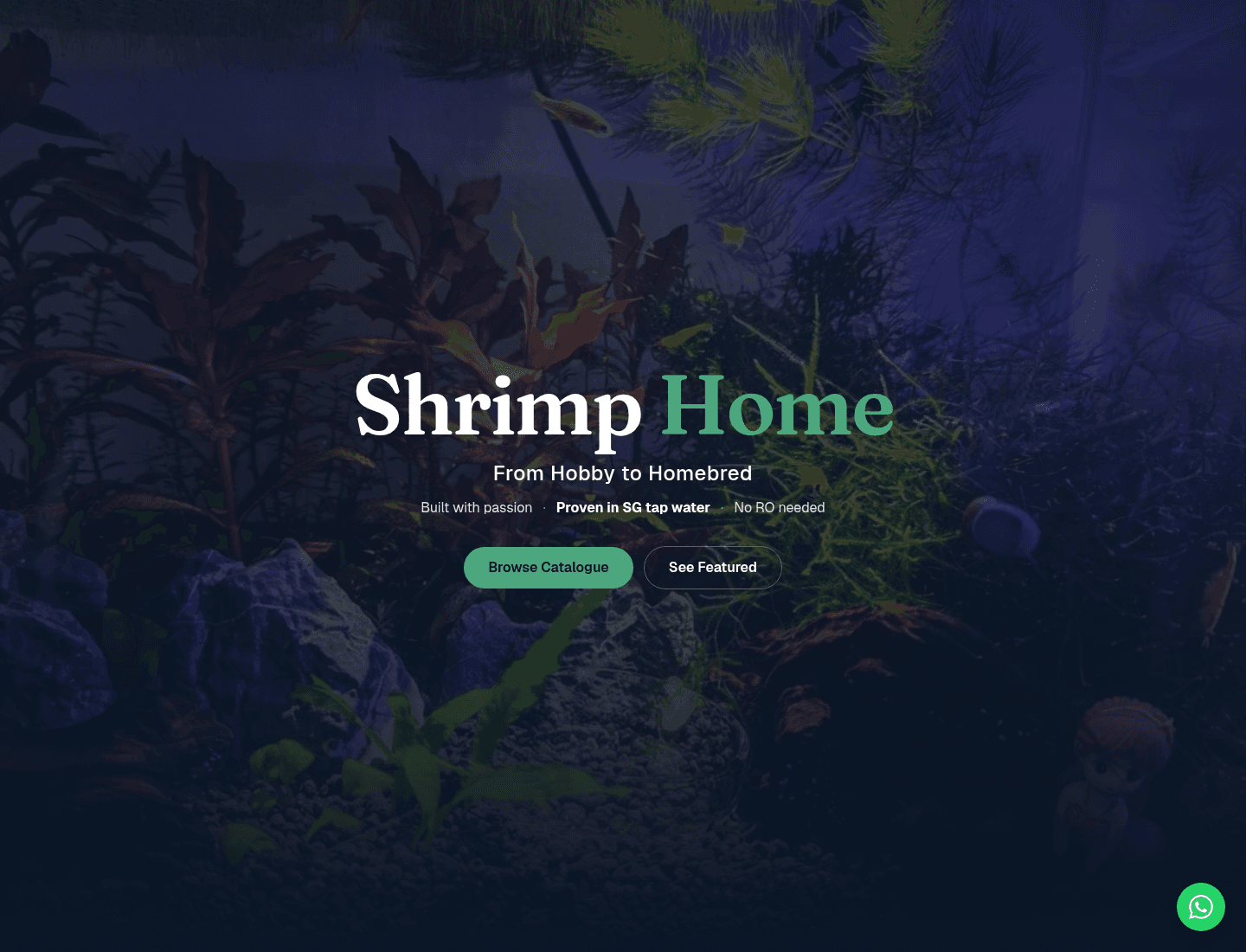
Shrimp Home homepage hero over a planted aquarium photograph, showing the wordmark, the tagline From Hobby to Homebred, the line Proven in SG tap water, and Browse Catalogue and See Featured buttons.

Homepage screenshot

Full-screen hero on the live site: the Shrimp Home wordmark, the line From Hobby to Homebred, and the claim the breeds are proven in Singapore tap water with no RO system needed.

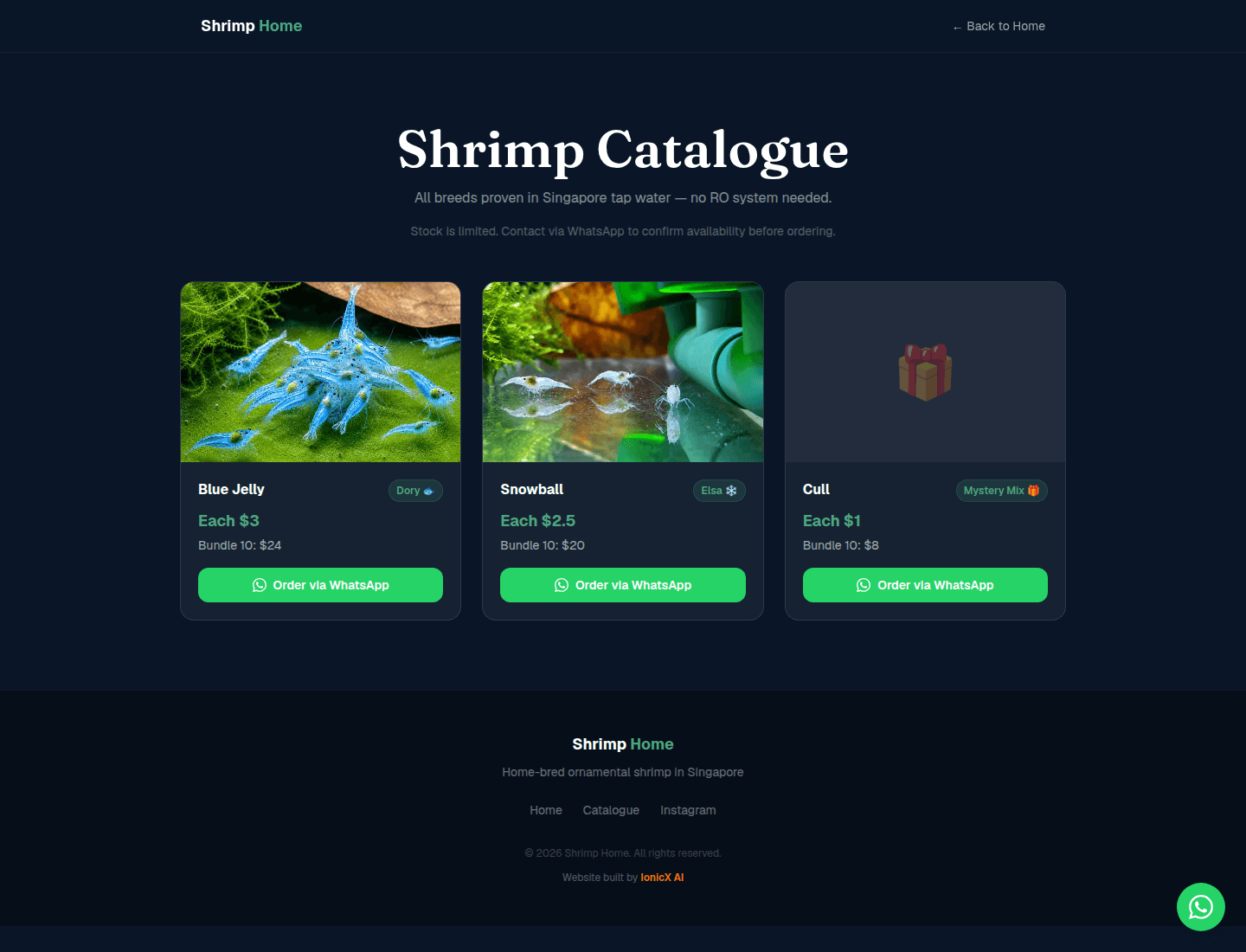
Shrimp Home catalogue page on a dark navy background with three breed cards - Blue Jelly, Snowball and Cull - each showing a photograph, a per-shrimp price, a bundle-of-ten price, and a green Order via WhatsApp button.

Catalogue screenshot

The live catalogue, read from the database: each breed card carries its own per-shrimp and bundle price and its own Order via WhatsApp button. There is no cart and no checkout anywhere on the page.

Problem

A home-based ornamental shrimp breeder in Singapore selling direct to hobbyists. Stock changes constantly and orders were already happening over WhatsApp, so a conventional e-commerce checkout would have added friction instead of removing it.

System

A public site at shrimphome.sg with a home page and a catalogue page, backed by a Supabase table so the stock list is live data rather than hard-coded. Every shrimp card opens WhatsApp with a message about that specific breed already filled in. A private admin area at /sh-hq lets the owner add, edit, and remove listings and upload photos himself, behind a bcrypt password and an authenticator-app second factor. A nightly Vercel cron job sends a traffic and enquiry-click summary over Telegram.

Current outcome

It shows a build shaped around how the business already sells, not around a default e-commerce template — and one the owner can keep current without calling us for every stock change.

System flow and implementation

  1. Step 1Establish how the business actually takes orders and gets paid.
  2. Step 2Model the catalogue as database records so stock and pricing stay editable.
  3. Step 3Build the public pages around browsing and a single WhatsApp next action.
  4. Step 4Add a password- and 2FA-protected admin area for self-serve updates.
  5. Step 5Wire structured data, llms.txt and an agent manifest for search and AI crawlers.
  6. Step 6Deploy to Vercel on the Singapore region with a nightly reporting cron.

Stack

Next.js 16 with the App Router and React 19Tailwind CSS v4 design systemSupabase for the catalogue and admin databcrypt password plus TOTP authenticator second factorVercel deployment (Singapore region) with a scheduled cron job

Current status

Live
  • Live on the client's own domain
  • Owner-editable catalogue, no developer needed for stock changes
  • Ordering path that matches how the business already sells
  • Admin area protected by two-factor authentication

Delivery timeline

  • Discovery on stock, pricing tiers, and the existing WhatsApp order flow
  • Design system and page production
  • Admin area, image upload, and two-factor login
  • Live deployment on the client's own domain

FAQ

Why is there no shopping cart or online checkout?

Because the business takes orders over WhatsApp and is paid by PayNow on collection. The site is built around that: each listing opens WhatsApp with a message about that breed prefilled, rather than pushing buyers into a checkout the seller does not use.

Can the owner update the shrimp list without us?

Yes. The catalogue reads from a database, and a private admin area lets the owner add, edit, and remove listings and upload photos directly. It is protected by a password and an authenticator-app code.